Mines Game: Free Play, Demo Mode and Real Money Guide

Last reviewed: 12 January 2026 · Reviewed by: Claire Bennett, Senior Casino Content Editor · Reading time: about 14 minutes

«Before looking at any headline bonus or multiplier grid, check the fine print, withdrawal terms and regulatory restrictions first. A useful review weighs risk, mechanics and compliance before it presents a single brand benefit.» Claire Bennett, Senior Casino Content Editor (source: editorial brief, pp99-site.com)

Provider

Stake Originals

RTP

99%

Volatility

High
Mines Game Free Play, Demo Mode
The short verdict

The short verdict

  • What it is:Mines is a grid-based arcade gambling game, a Minesweeper-style instant win product. You uncover safe tiles, the multiplier climbs, and you cash out before you hit a mine.
  • RTP:commercial builds usually advertise 95% to 98%. The Stake Originals version advertises 99% RTP with a 1% house edge, which is higher than most video slots (96% to 96.5%).
  • Main risk:high volatility plus full player agency creates an illusion of control. One mine wipes the whole stake for that round, and every extra pick lowers your survival odds.
  • Legality in Australia:under the Interactive Gambling Act 2001 (IGA), real-money online casino games, Mines included, cannot lawfully be supplied to people in Australia. Demo and free play are informational only.
  • Never pay for «predictors»:outcomes are pre-committed by a Provably Fair hash or a certified RNG. Predictor bots, signal apps and «hacks» are fraudulent. Full stop.

Editorial and affiliate disclosure: this guide is informational. Some outbound brand links may be commercial. We are not paid for favourable ratings, and the same compliance criteria are applied to every operator we review.

How we reviewed this game. A

How we reviewed this game

A quick word on method, because it explains why this guide leads with restrictions rather than multipliers.

Our reviewers played each Mines build in free play first, then compared the in-game help panel against the operator's public terms. Four things were checked every time: the stated RTP inside the game (not in marketing copy), the mine range and paytable coefficients, the fairness tooling, and the bonus weighting table that decides whether Mines counts toward wagering at all.

We also logged the friction points that cost players money rather than luck: mis-set mine counts, Autoplay stake escalators left switched on, and cash-out buttons that sit awkwardly under a thumb on mobile. Small details. They add up.

Where figures change often, such as bonus percentages, withdrawal windows and stake limits, we treat them as indicative and tell you to confirm the current page. Terms move without notice, and a review that pretends otherwise is not much use.

What is the Mines game and how does it work

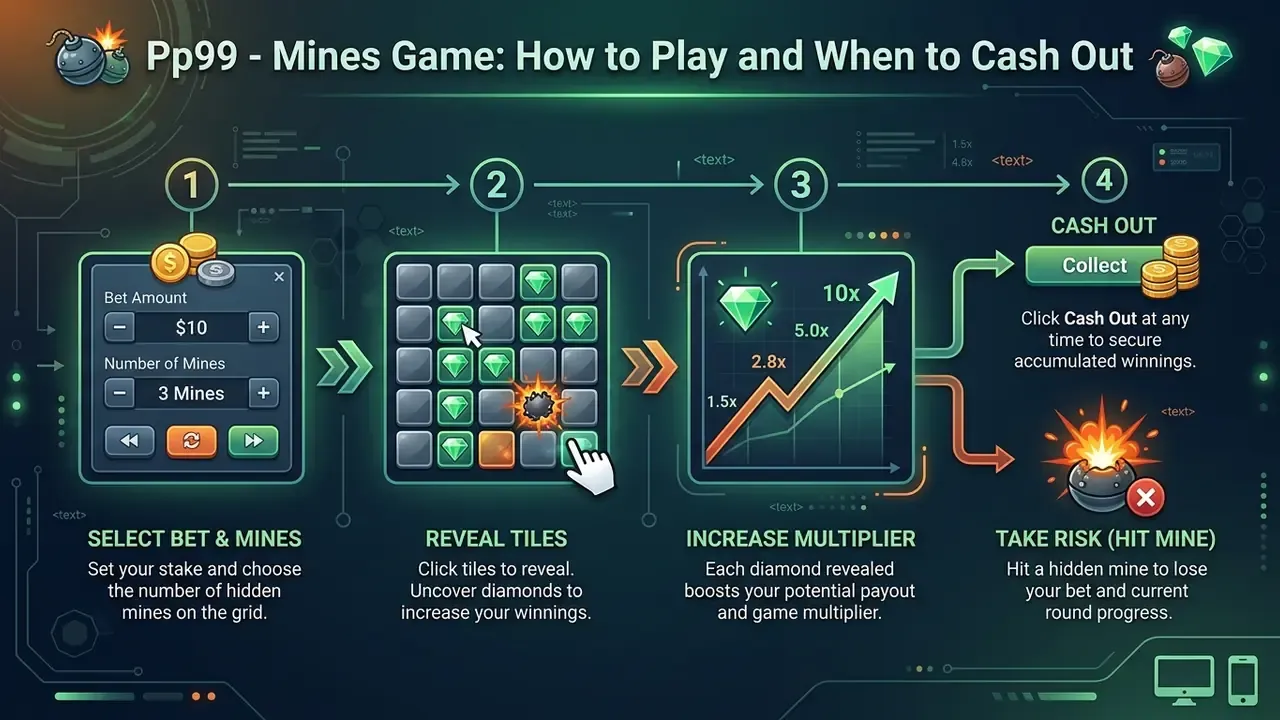
Mines is an interactive, chance-based arcade casino game played on a grid of concealed tiles. You uncover safe positions to build a payout multiplier while avoiding hidden mines. The mechanism rests on conditional probability: each safe pick lifts the active multiplier, while a single mine ends the round immediately and forfeits the wager.

Text version of the diagram: Step 1, set the stake amount. Step 2, select the mine count, which sets your risk baseline. Step 3, uncover tiles one at a time and watch the multiplier scale. Step 4 splits in two directions: hit a mine and the stake is lost for that round, or press cash out and the current multiplier is credited to your balance.

The flow follows a strict sequence. Set a bet, choose how many mines sit on the grid, reveal tiles, then decide after every successful pick whether to bank the profit or risk one more turn. That decision, repeated, is the whole game.

Game field, mines and multipliers. The

Game field, mines and multipliers

The standard Mines game field is a 5×5 grid of 25 tiles, and the player configures how many mines are hidden, typically anywhere from 1 to 24. A higher mine count raises the risk level and accelerates multiplier growth for every safe tile uncovered.

When a round is set up, the grid holds 25 positions, with m mines and 25 − m safe tiles. On the opening move, the probability of a safe pick is (25 − m) / 25. If that first pick is safe, the conditional probability of the second pick being safe falls to (25 − m − 1) / 24.

As safe tiles are cleared, the remaining hidden pool shrinks, so each move gets mathematically riskier.

To balance that escalating hazard, the payout multiplier grows exponentially with each successive safe pick.

How a fair paytable is derived. For a game with a given RTP, the theoretically fair multiplier after k safe picks equals:

$$M_k = \frac{\text{RTP}}{P(\text{Survival after } k \text{ picks})}$$

At 99% RTP with 3 mines and three safe picks, P = 0.7652, so the fair coefficient is about 1.29×. Displayed paytables differ between providers, because some front-load small multipliers and back-load the larger ones. Compare the in-game paytable rather than assuming a universal coefficient.

Autoplay, hotkeys and interface controls. Most

Autoplay, hotkeys and interface controls

Most commercial builds, including the Stake Originals and Spribe releases, ship with an Autoplay (auto-bet) module that repeats a pre-set pattern of picks without manual clicking. These controls deserve attention, because automation removes the pause between rounds where a player normally reconsiders their exposure.

Typical Autoplay parameters include:

  • Number of automatic rounds:usually configurable between 10 and 100 consecutive rounds, or «continuous» until stopped by hand.
  • Stop on profit / stop on loss:the session ends when the balance rises or falls by a nominated amount, for example stop at +$50 or −$25.
  • Increase on loss / increase on win:a percentage stake escalator that mechanically reproduces Martingale-style progressions.
  • Reset to base stake:returns the wager to its starting value after a win or a loss, depending on the setting.
  • Pattern selection:in the Spribe build you pre-select which tiles the bot opens each round, so the same «shape» repeats automatically.
  • Manual mode and keyboard shortcuts:manual play usually supports Space or Enter to start a round, plus a dedicated cash-out key or button. The cash-out control stays disabled until at least one safe tile is revealed.

Practical warning: stake escalators inside Autoplay compound risk faster than manual play, because losses repeat at increasing size with no human decision point. If you use Autoplay at all, set a stop-loss and a round cap before the first round, and prefer flat staking.

When to cash out in Mines

When to cash out in Mines

Cash out ends the active round and locks in the accrued multiplier before another selection is made. The current potential payout, calculated as the initial wager times the active multiplier, moves to your balance, and your exposure for that round is over.

Deciding when to press it means weighing incremental multiplier gains against a rising chance of landing on a mine. With 3 mines set, survival on the first pick is 22 / 25, or 88%. By the fourth pick, after three safe choices, the chance of another safe tile is 19 / 22, roughly 86.36%. The gap looks small. The cumulative effect is not.

While each success lifts the coefficient, one mine hit resets the multiplier to zero and forfeits the whole stake for that round. Probability modelling of arcade and crash formats reaches the same conclusion:

«Even where advertised RTP is as high as 97%, the expected value of individual bets remains negative, and the distribution of returns is heavily skewed toward losses.» Scott, Sher & Daigle, Cash or Crash: Return to Player Percentages and Expected Value of Crash Games (2026), gambling studies literature. (Note: this is an advance-access paper. Readers who want an established peer-reviewed baseline on expected value in arcade-style products may also consult Abarbanel and colleagues on volatility and player expectation.)

The practical implication is worth sitting with: realised RTP is not a fixed property of the game, it is a function of your cash-out discipline. Players who keep extending runs in pursuit of peak multipliers experience a lower effective return than the advertised figure, because the compounding risk of total loss eats the value of each extra pick.

Mines demo and Mines free play

Mines demo and Mines free play: testing without financial risk

Mines demo and free play let you experience the full mechanics, test interface responsiveness and watch multiplier scaling with virtual credits, at no financial cost. A demo version gives identical grid layouts, mine configuration settings and RNG behaviour, so you can see exactly how the game works in a risk-free environment.

Key characteristics of demo mode:

  • Virtual currency only. The balance is play money with no monetary value. It cannot be deposited to, cashed out or converted.
  • Identical rules and paytable. Grid size, mine range (1 to 24), multiplier progression and cash-out behaviour match real-money play. Demo does not run a «generous» RTP setting. The maths are the same.
  • No withdrawal path. Nothing won in free gameplay is redeemable.
  • Some platforms require registration. Many offshore sites gate demo play behind an account, while provider showcase pages, such as Hacksaw Gaming's Dare2Win hub, usually allow instant play behind an age prompt with no sign-up.

[Media placeholder: checklist, semantic ordered list, indexable as text. Title: «Checklist for your first Mines demo session».]

  1. Find a verified platform that offers Mines demo or free play without a deposit.
  2. Confirm the demo balance uses virtual credits and clearly displays a non-monetary currency.
  3. Set the grid configuration by choosing a mine count (say 1, 3 or 5) and watch how difficulty changes multiplier escalation.
  4. Make several picks across the grid to observe tile reveals, multiplier scaling and audio-visual feedback.
  5. Test the cash out button after 1, 2 and 3 safe picks, so you know how virtual winnings are secured.
  6. Open the Autoplay panel and set a deliberately small round count with a stop-loss, to see how automation changes session length.
  7. Open the in-game «Help» or «Fairness» tab, then locate the stated RTP and the Provably Fair seed or hash verification tool.

Testing Mines free play also lets you examine volatility across different mine settings, which is hard to picture from a paytable alone. Updated: in our editorial comparative review of iGaming brand mechanics, reviewers found that walking through risk controls, paytables and cash-out behaviour in free mode reduced avoidable operational errors, such as mis-set mine counts or an unnoticed Autoplay escalator, once testers moved to structured play. That is an internal observation from hands-on testing, not a controlled study, and should be read that way.

Evidence on simulated gambling still warrants real caution:

«Engagement with simulated gambling was associated with greater harm from monetary gambling, independent of the specific structural mechanics.» Gainsbury et al., Order of first-play in simulated versus monetary gambling (2024).

«Adolescents who played social casino games in the last month were 2.5 times as likely to meet criteria for gaming disorder as those who did not engage in simulated gambling.» Hing et al., Not all games are created equal (2023).

The Australian Gambling Research Centre's literature review lands in the same place, reporting that greater involvement in simulated gambling was linked to higher problem gambling scores even after accounting for demographics, impulsivity and monetary gambling.

So use demo modes strictly to inspect software behaviour and rules, never as a guide to future returns. Free-play sequences are not representative samples. Short demo runs frequently produce win rates that would be unsustainable across thousands of real-money rounds.

Editorial resource: if you want to compare demo availability, stated RTP and withdrawal terms across brands before committing anything, our regularly updated casino platform reviews on pp99-site.com set out licensing, payment rails and bonus weighting side by side.

Provider versions compared: Hacksaw, Spribe and Stake Originals

«Mines» is not a single product. Several studios ship mechanically similar builds with different stake ranges, caps and fairness tooling, and those differences change your risk profile.

SpecificationHacksaw Gaming (Dare2Win Mines)Spribe MinesStake Originals Mines
Release3 March 2022Post-2022 instant-win rangeStake in-house original
Grid5×5 (25 tiles)5×5 (25 tiles)5×5 (25 tiles)
Mine rangePlayer-configurablePlayer-configurable1 to 24
Advertised RTPTypically 96% to 98%, check in-game helpTypically 96% to 98%99% (1% house edge)
Minimum bet$0.20Operator-dependentFractional crypto units (sub-cent)
Maximum bet$1,000Operator-dependentOperator or VIP dependent
Max exposure / win cap10,000×Operator-dependentCapped by paytable and table limits
AutoplayYes, with win/loss stop limitsYes, plus saved tile-pattern auto-playYes, with stake escalators and stop conditions
Fairness toolingCertified RNG under regulated licencesProvably Fair hash history, one-click verificationProvably Fair (server seed, client seed, nonce)
Studio licensingMalta Gaming Authority (MGA/CRP/501/2018), Great Britain Gambling Commission, Hellenic Gaming Commission, Isle of Man supply licenceStudio-level supplier licencesOperated by Stake under offshore licensing
Design emphasisMinimalist UI, fast animation, regulated-market compliancePattern automation and hash transparencyMicro-stakes crypto play, no animation delay
The practical takeaways the Hacksaw build

The practical takeaways: the Hacksaw build is the version most likely to appear in regulated European markets, with a hard 10,000× exposure cap and a clear $0.20 to $1,000 stake band. The Spribe build is the most automation-friendly, thanks to saved tile patterns. The Stake Originals build carries the highest advertised RTP, and it also sits with an offshore operator, which changes your consumer-protection position entirely. Worth remembering when you see a «Stake Mines strategy» thread promising an edge on stake.com or the Stake US social version: the maths of the build is not the same thing as the safety of the brand hosting it.

Mines casino: how real money access works

Reaching a Mines casino game for real money means picking a licensed operator, completing identity verification and reading the platform's withdrawal conditions. Real money play involves depositing actual funds, staking a cash balance and withdrawing any winnings, subject to compliance requirements.

E-E-A-T compliance and operator fact check Before recommending or registering with any platform that offers real money casino games, our editorial team verifies four things:

  1. Regulatory status: the operator's licence under applicable state or international authorities. Under Australia's Interactive Gambling Act 2001, real money online casino services, including slots and arcade games such as Mines, are prohibited from being provided to people in Australia.
  2. Financial terms: published withdrawal caps, minimum payout thresholds and processing timelines.
  3. Verification protocols: the mandatory Know Your Customer (KYC) triggers that apply before a withdrawal is processed.
  4. Safer gambling standards: binding deposit limits, cooling-off periods and self-exclusion tools such as BetStop in Australia.

One clarification that trips people up. Many betting sites present online betting markets and a casino lobby under one account. In Australia, licensed operators may lawfully offer online sports betting, yet the same rules do not extend to online casino games. So a brand you know from sports betting will not legally serve you Mines locally, and any site that does is operating outside the domestic framework.

The offshore reality what the IGA

The offshore reality: what the IGA means in practice

The IGA regulates suppliers, not players. That distinction produces a specific set of consumer risks worth understanding before you deposit anywhere:

  • No local regulator to complain to. If an offshore site voids a win, applies an undisclosed cap or freezes an account, the Australian Communications and Media Authority (ACMA) can investigate and pursue site blocking or referral, but it cannot recover your money. ACMA's enforcement reporting shows a steady pipeline of investigations and blocking requests against illegal offshore services.
  • Payment friction and reversals. Deposits may be declined by Australian banks, routed through third-party intermediaries, or labelled as non-gambling transactions, which complicates chargebacks and dispute evidence.
  • Withdrawal delays and shifting terms. Turnover requirements, «bonus abuse» clauses and repeated identity checks are common reasons for stalled payouts at unlicensed sites.
  • No BetStop coverage. Australia's national self-exclusion register applies to licensed wagering providers. Offshore casinos are not connected to it, so a domestic self-exclusion will not block access.
  • Data and AML exposure. You are sending passport, licence and bank documents to an entity outside Australian privacy and AML/CTF supervision.

What to check at a Mines casino before you register

Disclaimer: this section is general information only, not legal, financial or medical advice. Real-money online casino services may be unlawful to supply in your jurisdiction, and participation can carry legal and financial consequences. Consider independent advice. If gambling has stopped being entertainment, free confidential support is available through Gambling Help Online on 1800 858 858 (24/7) or Lifeline on 13 11 14.

Before creating an account or depositing, examine the operator's rules, payment friction points and support standards. Checking transparency first prevents most of the familiar problems: delayed payouts, surprise restrictions, offers that quietly exclude the game you came for.

Key parameters to inspect:

Pp99 heading-banner
  • Licensing and legal scope:the issuing jurisdiction, licence number and expiry, plus whether interactive casino services are restricted or blocked in your region.
  • Cash out and withdrawal caps:daily, weekly or monthly maximum payouts, and processing fees on local payment methods.
  • RTP transparency:the official Return to Player figure should appear in the game help menu, not only in marketing copy. Expect 95% to 98% for standard builds, up to 99% for Stake Originals.
  • KYC documentation:which documents (photo ID, proof of address, bank statements, source-of-funds evidence) are required before a cash out is released, and at what threshold they trigger.
  • Game weighting rules:confirm in writing whether Mines contributes to wagering requirements at all.
  • Responsible gambling infrastructure:player-set loss limits, deposit caps, session reality checks, cooling-off periods and visible links to support services.

For context on why RTP is a regulated disclosure rather than a marketing claim:

«RTP is the proportion of each wager an EGM game is designed to return on average to users.» Regulators typically set minimum RTP ranges, for example 85% to 87.5% for club and pub machines, with casino machines often higher. Australian Institute of Family Studies, How electronic gambling machines work.

Arcade titles such as Mines sit outside those Australian EGM minimums entirely, which is exactly why the in-game disclosure matters.

Payments, withdrawal times and KYC

Payment practicalities are where most real-money frustration begins. Indicative characteristics of the methods Australian readers meet most often:

MethodTypical deposit speedTypical withdrawal speedNotes
PayID / bank transfer (Osko)Near-instant to 1 business day1 to 3 business daysWidely used locally; banks may decline gambling-coded transfers
Cryptocurrency (BTC, ETH, USDT)Minutes, network dependentMinutes to 24 hoursFastest payout rail; network fees and price volatility apply; no chargeback protection
Neosurf / prepaid vouchersInstantNot available for withdrawalDeposit only; you need an alternate payout method
Debit cardInstant to 1 day3 to 5 business daysAcceptance varies by issuer
Credit cardGenerally unavailableNot applicableCredit-card payments for online gambling are prohibited in Australia under amendments to the interactive gambling framework; any operator offering it is a red flag
E-walletsInstant24 to 72 hoursSome wallets exclude gambling merchants in their own terms
The timeframes above are ranges observed

The timeframes above are ranges observed across the market, not guarantees. Always confirm the current cashier page. Two further points get underestimated constantly:

  1. KYC is triggered at withdrawal, not deposit. Expect to supply photo ID and proof of address, and for larger sums, source-of-funds documentation. Sending those before your first withdrawal request usually cuts several days off the wait.
  2. Deposit limits are the single most effective control. Australian online wagering research consistently finds that binding, pre-committed deposit limits are among the most useful harm-reduction tools available, and that they work best when set at account opening, before losses create pressure to raise them.
Welcome bonus, promo code and the

Welcome bonus, promo code and the wagering maths

A welcome bonus or promo code offers extra funds, a deposit match or free plays when you register or top up. Headline figures look generous. The terms and conditions decide whether the offer has any practical value for an arcade game like Mines.

Typical market offers show the pattern: a 200% deposit match up to $2,000 plus 5% rakeback at real-money crypto casinos, or 55 Sweeps Coins plus 260,000 Gold Coins style packages on social and sweepstakes platforms. The headline number is rarely the operative term. Weighting and turnover clauses are.

Game weighting is the decisive variable. In many online casinos, slot games contribute 100% toward bonus wagering thresholds, whereas crash games and mines-style arcade titles commonly contribute far less, frequently in the 5% to 20% band, or nothing at all. Because high-RTP, low-house-edge games are cheap for players to turn over, operators restrict them as a matter of routine. Treat any specific contribution percentage as brand-specific and verify it in the current T&Cs, since these figures change without notice.

Worked example, and this is where the shine comes off:

  • Bonus: $100 with a 30× wagering requirement on the bonus amount, so nominal turnover of $3,000.
  • If Mines contributes 10%, every $1 staked counts as $0.10.
  • Required Mines turnover: $3,000 ÷ 0.10 = $30,000.
  • At an average $2 stake per round, that is roughly 15,000 rounds. At 99% RTP, with 1% expected loss per unit staked, the expected theoretical cost of clearing a $100 bonus is about $300.

That arithmetic turns an apparently generous offer into negative value. Reading the fine print also prevents the worse outcome, where playing Mines fails to advance clearance at all, or triggers forfeiture because the game sits on a restricted list. Check four more items while you are there: maximum bet while a bonus is active (often $5 or less), maximum cash-out from bonus winnings, expiry window (commonly 7 to 30 days), and whether unclearable bonus funds are stripped automatically.

Comparison featureLicensed Australian-facing operator (wagering only)Offshore online casino operator
Mines real money availabilityProhibited for people in Australia under the IGA 2001Offered, but outside Australian regulatory frameworks
Demo / free play modeAvailable for educational and informational testingAvailable, often behind account creation
Welcome bonus and promo codeLimited to licensed wagering and sports products, with strict advertising rulesHeavily promoted, for example 200% match up to $2,000 plus rakeback
Wagering contribution on MinesNot applicable, casino arcade games excludedTypically 5% to 20%, or excluded; max-bet caps apply while a bonus is active
Cash out and withdrawal rulesStrict identity checks with standard local bankingVariable speeds; risk of undisclosed turnover conditions or fees
Payment railsPayID, bank transfer, debit (credit cards prohibited)Crypto, vouchers, third-party processors; higher friction on disputes
Responsible gambling toolsMandatory integration with BetStop and national standardsDiscretionary tools, limited external oversight
Dispute resolutionDomestic regulator and ombudsman pathwaysOffshore licensing body only; ACMA can block, but cannot recover funds

Mines strategy: how to choose risk and mine count

A Mines strategy is a structured approach to stake sizing, mine configuration and cash-out targets, designed to manage bankroll variance rather than alter the odds. Mine positions are generated randomly for every round, so no system overcomes the house edge or guarantees long-term profit. What a strategy can do is define your volatility, your average session length and the size of your worst plausible losing streak.

Throughout this section, the fair multiplier at 99% RTP is calculated as 0.99 divided by the survival probability. Provider paytables may differ slightly.

Low Risk Play and the 1

Low Risk Play and the 1:1 ratio strategy

Low Risk Play, often described as a conservative or 1:1 ratio approach, means setting a low mine count, say 1 or 2, and cashing out after one safe pick or a handful of moves. It minimises the immediate chance of a mine on any given turn and delivers frequent, small multiplier gains.

On a 25-tile grid with 1 mine, the chance of a safe first pick is 24 / 25, or 96%. Cashing out after that single pick yields roughly 1.01× to 1.03×, depending on the paytable.

High win frequency, though, is not the same as an edge. One mine hit erases the accumulated gains of dozens of small consecutive wins. The 1:1 ratio is a volatility control, nothing more, and it does not move expected value in the player's favour.

Setup: manual mode, 1 mine, one pick, flat stake, immediate cash out. This is the sensible configuration for a first real-money session, precisely because it makes the house edge visible instead of hiding it behind big swings.


Moderate: 3 mines and three picks

A natural step up. With 3 mines and three safe picks required:

P = 22/25 × 21/24 × 20/23 ≈ 76.52%

Fair payout at 99% RTP is around 1.29×. Roughly three rounds in four succeed, and the loss on the fourth wipes out slightly more than the accumulated profit. That is what a 1% house edge looks like in practice, up close.

Balanced 7 mines and three picks

Balanced: 7 mines and three picks

Seven mines with three safe reveals is the most commonly cited «middle» configuration. It demands genuine bankroll discipline, and it should not be attempted on a depleted balance.

P = 18/25 × 17/24 × 16/23 ≈ 35.48%

  • Fair payout at three picks:0.99 ÷ 0.3548 ≈ 2.79×.
  • Extend to four picks:P = 0.3548 × 15/22 ≈ 24.19%, giving a fair payout near 4.09×, which is where the widely quoted «around 4× your wager» claim for the 7-mine setup comes from.
  • Interpretation:you lose roughly two rounds in three at three picks, and three in four at four picks. Session variance is substantial.

More mines: raising volatility deliberately

The «more mines» approach simply increases mine density to inflate the multiplier per safe pick. Every extra mine raises reward per reveal and shortens the average round. It is a volatility dial, not an edge. Expected value per unit staked stays fixed by the house edge, whatever mine count you choose.

The Martingale progression what it actually

The Martingale progression: what it actually does

Doubling the stake after each loss and reverting to base after a win is an old casino system, and it is popular among Mines players. Its maths deserves plain language: Martingale converts a large number of small wins into a small number of catastrophic losses. Eight consecutive losses at a $1 base stake require a $256 wager on the ninth round, with $511 already committed. It does not change expected value. It changes the shape of your loss distribution and sharply raises the chance of meeting a table limit or a zero balance. Paired with an Autoplay escalator, it is the fastest known way to empty a Mines bankroll.

Aggressive all-in on 24 mines, the

Aggressive: all-in on 24 mines, the «YOLO» setup

The maximum-risk configuration places 24 mines on the grid, leaving exactly one safe tile, with a single pick.

  • Probability of success:1 / 25, or 4%.
  • Fair payout at 99% RTP:0.99 × 25 = 24.75× for one click, with slight variation by provider.
  • Where the «millions of ×» claims come from:promotional copy citing wins «over 5,000,000×» refers to chained extreme outcomes, successive all-in rounds or deep runs at very high mine counts, not a single-round coefficient. Compounding such results is vanishingly unlikely: two consecutive all-in wins occur with probability 0.04², or 0.16%, and three with 0.0064%.
  • Verdict:a lottery-style bet with a 96% chance of losing the stake outright each round. It has no bankroll-management application at all.
Why no Mines strategy guarantees a

Why no Mines strategy guarantees a win

No betting system guarantees a win in Mines, because every tile reveal rests on a Provably Fair algorithm or a certified Random Number Generator. Provably Fair technology uses cryptographic hashing, combining a server seed, client seed and nonce, so mine locations are fixed before the round begins and cannot be altered or predicted.

Mathematically, for any grid with m ≥ 1 mines, survival across k consecutive safe picks is the product of the individual conditional probabilities:

$$P(\text{Survival}) = \prod_{j=0}^{k-1} \frac{25 - m - j}{25 - j}$$

Every term in that product is strictly less than 1, so survival probability falls with every move. Under NIST SP 800-22 Rev. 1a, A Statistical Test Suite for Random and Pseudorandom Number Generators for Cryptographic Applications (National Institute of Standards and Technology, 2010), verified cryptographic RNG outputs are statistically independent and non-deterministic. Historical patterns, «hot» tiles, corner-versus-centre heuristics and grid-shape systems therefore carry zero predictive value.

One point deserves stating outright: in a Provably Fair implementation the outcome is committed before your first click, via a hashed server seed. Your picks do not influence where the mines sit. They only reveal what was already fixed. That is why fairness can be verified after the fact, and why it can never be exploited in advance. If you want to check it yourself, copy the round's server seed hash, client seed and nonce from the fairness tab and run them through the provider's verifier once the seed is rotated.

⚠️ Alert: gambling risk and strategy misconceptions

  • No guaranteed returns: Mines is a gambling game, and every wager carries the risk of total loss.
  • Calculators and signal apps: third-party «Mines predictor» apps, software hacks, signal bots and paid Telegram «signals» claiming to identify safe tiles are fraudulent and mathematically impossible against cryptographic hashing. Many are malware or credential-harvesting tools.
  • Bankroll management: automated progressions such as Martingale can drain a balance quickly during losing streaks, especially inside Autoplay.
  • Illusion of control: choosing the tiles yourself does not make the outcome skill-based. Perceived control is a documented driver of over-extended play in arcade formats.
  • Safer play: set loss and deposit limits before you start. If gambling stops being recreational, contact Gambling Help Online on 1800 858 858, register with BetStop, or call Lifeline on 13 11 14.

Mines RTP, risk and win probability

RTP in Mines is the theoretical share of total wagered money the game returns to players across millions of rounds. Updated: commercial implementations commonly advertise between 95% and 98%, the Hacksaw Gaming release included, while the Stake Originals build advertises 99% RTP with a 1% house edge, one of the highest returns in the arcade category. In every case the operator keeps a structural edge, and RTP is a long-run average that says nothing about your session.

How mine count changes the odds

The table shows how the mine count alters initial risk, multiplier scaling and survival probability on a 25-tile grid. Multiplier ranges are illustrative across providers; the fair-value column applies 0.99 ÷ P.

Number of minesRisk categoryExample multiplier (1st safe pick)Example multiplier (3rd safe pick)Chance of surviving 3 picksFair 3-pick multiplier at 99% RTP
1 mineMinimal~1.01× to 1.03×~1.10× to 1.14×24/25 × 23/24 × 22/23 ≈ 88.00%~1.13×
3 minesLow~1.08× to 1.12×~1.38× to 1.45×22/25 × 21/24 × 20/23 ≈ 76.52%~1.29×
5 minesMedium~1.18× to 1.22×~1.80× to 1.95×20/25 × 19/24 × 18/23 ≈ 62.61%~1.58×
7 minesMedium-high~1.30× to 1.38×~2.75× to 2.90×18/25 × 17/24 × 16/23 ≈ 35.48%~2.79×
10 minesHigh~1.52× to 1.60×~3.80× to 4.20×15/25 × 14/24 × 13/23 ≈ 19.57%~5.06×
15 minesExtreme~2.35× to 2.50×~14.0× to 16.0×10/25 × 9/24 × 8/23 ≈ 5.22%~18.97×
24 minesMaximum (all-in)~24.75× on a single pickn/a1/25 = 4.00% for one pick~24.75×

As the data shows, 15 mines inflates potential multipliers quickly, while the chance of surviving just three picks falls to about 5.22%. High advertised RTP indicates an efficient long-term paytable. It does not shield an individual session from volatility or rapid bankroll depletion. A 99% RTP game can, and regularly does, produce twenty losing rounds in a row.

Editorial resource: RTP is only one variable. Stated return, withdrawal caps, payment rails and bonus weighting are easier to judge together, which is how we present them in our independent casino platform comparisons at pp99-site.com.

Mines mobile and Mines download playing

Mines mobile and Mines download: playing from a phone

Mines mobile runs directly on smartphones and tablets through a mobile browser, with no dedicated app or executable download. Built on HTML5, the interface scales to touchscreens and gives you large tap targets for tile selection and cash out.

No standalone application or third-party package is needed to play Mines online. Avoiding external executables removes the security risk attached to unverified APKs and unauthorised software files. Where an operator does offer a native app, it usually mirrors the desktop lobby. Sideloading an APK from a non-store source should be avoided outright, and any «Mines hack» or «predictor APK» should be treated as malware.

Interface details that matter on a phone:

Pp99 heading-banner
  • Tap precision:on a 5×5 grid at phone width, adjacent tiles sit close together, and mis-taps at high mine counts are expensive.
  • Cash-out placement:check where the cash-out control sits relative to the grid before you play for money, so you are not hunting for it mid-round.
  • Session pacing:mobile rounds can finish in under two seconds, which compresses hundreds of decisions into a short sitting.

Australian participation data underlines why pacing matters:

«Online gambling through mobile devices is associated with continuous gambling, leading to losses and gambling harm at a faster rate than in venues.» Gambling participation in Australia 2024, Australian National University (2024). The same study reports that 33.4% of adults gambled online in the preceding 12 months.

«A majority of young adult participants gambled on mobile devices, typically during sports seasons and around high-profile games and finals.» Young adults gambling online in the ACT (2024).

That rapid feedback loop makes session resets almost frictionless, which is exactly why time and spend limits matter more on a phone than on a desktop. Three practical controls: switch on an in-game reality check, set a timer on the device itself, and remove stored payment credentials from the browser.

Mines game compared with crash games and slot games

Mines is an interactive arcade game that hands the player direct agency over tile choices and cash-out timing, which sets it apart from continuous crash games and traditional slot machines. All three categories rely on certified RNG mechanisms and carry negative expected value. The gameplay structures, though, differ sharply in how involved you are.

FeatureMinesCrash gamesVideo slots
Player inputs per roundTwo (tile picks plus cash-out timing)One (cash-out timing)None after the spin starts
Round lengthPlayer-determinedSeconds, server-pacedFixed animation
Volatility controlDirect, via mine countIndirect, via target multiplierFixed by game design
Typical advertised RTP96% to 99%About 97%About 96% to 96.5%
Bonus wagering weightingOften 5% to 20%, or excludedOften restrictedUsually 100%
Perceived controlHighestModerateLowest

In standard slot games, you set a stake and trigger a spin. The outcome is decided entirely by the server-side RNG, with zero influence over reel stops, symbol reveals or cash-out timing. Slots also deploy a structural feature Mines largely lacks, the «loss disguised as a win», where a payout smaller than the stake arrives with celebratory sound and animation:

«Mean estimated genuine win count was 3.02 versus a true count of 2.14 in the condition containing losses disguised as wins, a medium effect size (d = 0.44).» Experimental study on losses disguised as wins in electronic gaming machines (2024), available via PubMed Central.

In a crash game such as Aviator, you place a bet and watch a rising multiplier curve. One decision point only: when to hit cash out before the crash.

«Despite advertised RTP as high as 97%, players' realised RTP varies widely depending on cash-out strategy.» Scott, Sher & Daigle, Cash or Crash (2026).

In Mines, you keep two separate inputs: grid difficulty through mine placement, and tile selection one by one. That dual-input structure creates a strong sense of active participation. Which raises the obvious question, does more control mean better odds? No. Tile reveals stay mathematically independent of your choices, the board is fixed before the first click, and long-run outcomes remain governed by the house edge. If you want to see how crash games and slots differ in structure and volatility, our category guides break down each format's mechanics.

Who should skip this game. An

Who should skip this game

An honest guide has to name the readers for whom Mines is a poor fit:

  • Anyone chasing losses. Short rounds and instant restarts make Mines one of the worst possible formats for loss-chasing.
  • Anyone drawn mainly by the 99% RTP figure. A low house edge on fast, repeatable rounds still produces substantial expected loss through sheer turnover.
  • Anyone hoping to clear a bonus with it. Low weighting usually makes Mines the least efficient route to a wagering requirement.
  • Anyone who has bought, or is considering buying, a predictor tool. If a product's premise is that outcomes are predictable, the product is a scam.
  • Anyone registered with BetStop or another self-exclusion program. Offshore casinos are not connected to Australia's register, so treat any urge to seek them out as a signal to contact support services, not a workaround.
  • Anyone under the legal age, or gambling with money needed for essentials. No strategy in this article changes that calculus.

FAQ: Mines questions from Australian players

Respuestas renderizadas en formato acorde al diseГ±o exportado: tarjetas oscuras, acento dorado y despliegue compacto.

1

Is Mines legal to play for real money in Australia?

Real-money online casino games, Mines included, cannot lawfully be supplied to people in Australia under the Interactive Gambling Act 2001. The Act targets suppliers rather than players, but using offshore sites means no Australian regulator can help recover funds, and BetStop self-exclusion does not apply.
2

What is the RTP of Mines?

Commercial builds commonly advertise 95% to 98%. The Stake Originals version advertises 99%, a 1% house edge. Confirm the figure inside the game's help panel, since operators can configure different versions.
3

How many mines can I place on the grid?

Standard implementations allow between 1 and 24 mines on a 5×5, 25-tile grid. More mines means higher multipliers per safe reveal, and a much shorter expected round.
4

When is the best time to cash out?

Mathematically, no moment beats the house edge. Cashing out after one to three safe picks minimises variance, while extending runs raises the chance of losing the accrued multiplier entirely. The disciplined approach is to set a target multiplier before the round and honour it.
5

Do Mines predictors, calculators or signal bots work?

No. Outcomes are pre-committed through cryptographic hashing (server seed, client seed, nonce) or generated by a certified RNG. Prediction is mathematically impossible, and paid predictor products are fraudulent, frequently bundled with malware.
6

Is Mines rigged?

In Provably Fair implementations you can verify each round's outcome against the published hash after play. What cannot be changed is the house edge, which is built into the paytable by design rather than applied covertly.
7

Do I need to download anything to play Mines?

No. Mines runs in HTML5 in a mobile or desktop browser. Avoid any APK, executable or «hack» download claiming to be Mines.
8

Does Mines count toward bonus wagering requirements?

Frequently not, or only at a heavily reduced rate, commonly 5% to 20%. Verify the weighting table in the operator's current bonus terms before you deposit for an offer.
9

What is the maximum win in Mines?

It depends on the build. The Hacksaw Gaming release carries a 10,000× maximum exposure. The all-in 24-mine setup pays roughly 24.75× on a single 4% chance, and marketing claims of multi-million-× wins refer to chained extreme outcomes with negligible probability.
10

How long do withdrawals take?

Indicatively: cryptocurrency minutes to 24 hours, PayID or bank transfer 1 to 3 business days, debit card 3 to 5 business days. KYC verification is the most common cause of delay, so submit documents before requesting your first payout.
Responsible gambling and disclaimer. Gambling products

Responsible gambling and disclaimer

Gambling products are designed to return less than they take in over time. Nothing here is legal, financial or medical advice, or a recommendation to gamble. Real-money online casino services may be unlawful to supply in your jurisdiction, and availability, terms, RTP figures and promotional offers change frequently, so always verify current terms with the operator.

Set deposit, loss and time limits before you play. Never gamble with borrowed money or funds needed for essentials, and treat gambling as entertainment rather than income.

Free, confidential support in Australia: Gambling Help Online, 1800 858 858 (24/7, gamblinghelponline.org.au) · BetStop, the National Self-Exclusion Register · Lifeline, 13 11 14. Support for family and friends is available through the same services. 18+ only.