Poker Online in 2026 Formats, Rules

Poker Online in 2026: Formats, Rules, Live Dealer Technology and the Australian Rulebook

Last updated: February 2026 · Reviewed by: Claire Bennett, senior casino content editor (editorial persona), with the iGaming editorial desk · Reading time: about 28 minutes

How we built this guide: we combined product-level testing of live dealer poker tables and poker clients, published rule sets from major live studio suppliers, Australian legislation and regulator enforcement records (ACMA, eSafety Commissioner), tax guidance from the Australian Taxation Office, and peer-reviewed gambling research from 2024 to 2025. Where a claim rests on industry convention rather than published data, we say so out loud. Where the topic touches money, law or health, you will find a disclaimer.

The short version what actually matters

The short version: what actually matters

  • "Poker online" is not one product. It splits into three quite different things: peer-to-peer poker (you play other players, the room takes rake), house-banked casino poker (you play the dealer and a paytable, outcomes are RNG-generated), and live dealer poker (a human dealer streams from a studio, yet you are still playing the house).
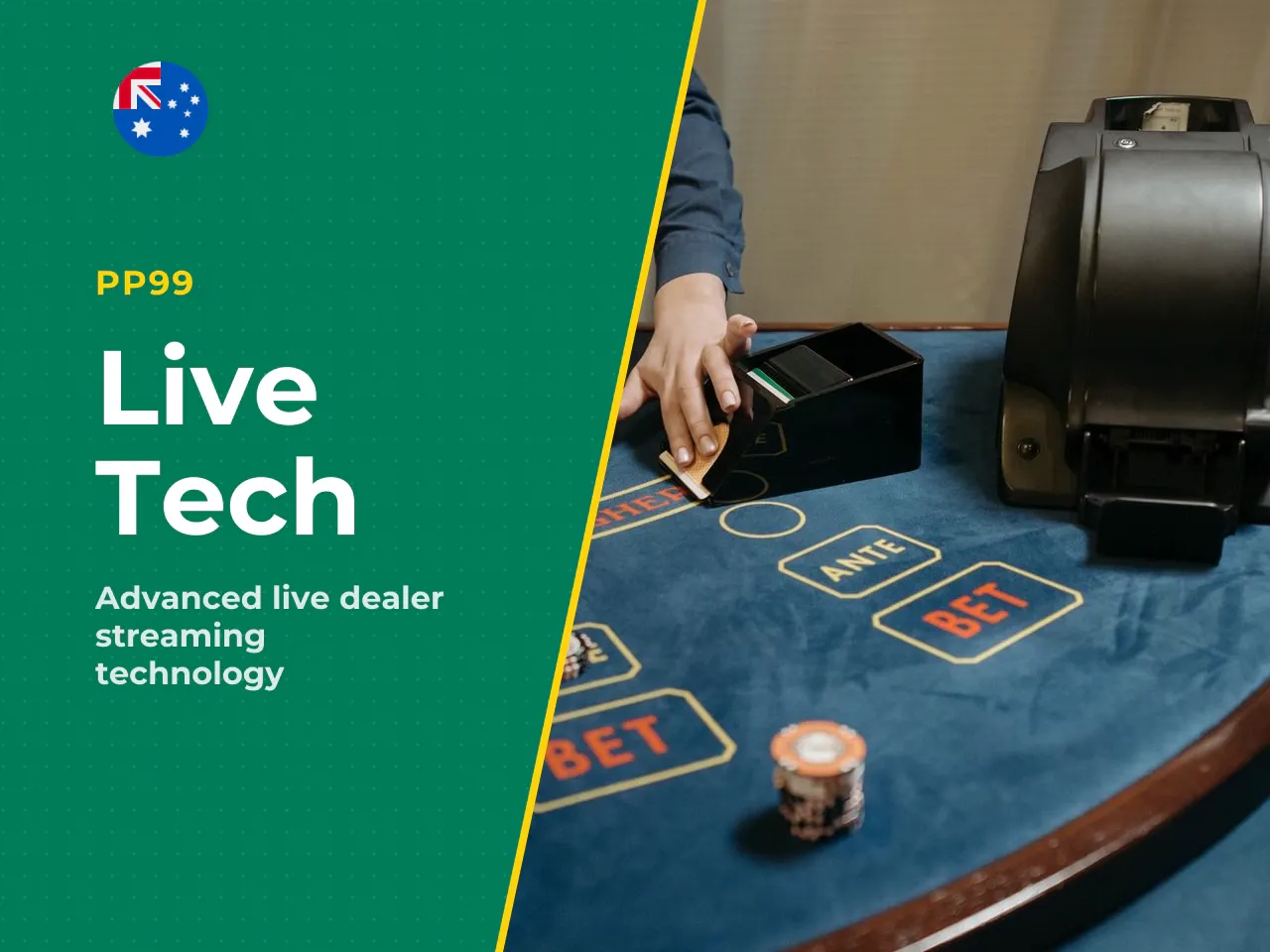
  • Live dealer poker is a technology stack, not just a camera on a felt table. Three components matter: OCR (optical character recognition) to digitise cards, the GCU (Game Control Unit) bolted under each table to encode the video feed, and studio management software that syncs your bets to a real dealer's actions.
  • Ten hand rankings, four betting rounds, six stages. Learn the hierarchy (Royal Flush down to High Card) and the sequence (blinds, pre-flop, flop, turn, river, showdown) and you can sit at any poker table in the world.
  • Variants differ on dealer qualification and maximum payouts. Casino Hold'em pays up to 100:1 on the Ante; Caribbean Stud pays up to 100:1 on the Call and up to 1000:1 on the 5+1 Bonus; the Caribbean Stud dealer only qualifies with Ace-King or better.
  • Australia is restrictive. Under the Interactive Gambling Act 2001, supplying real-money poker online to Australians is prohibited, and since June 2024 credit cards and cryptocurrencies cannot be used for online gambling payments.
  • Recreational winnings are generally not taxed in Australia; professional gambling carried on as a business is treated differently. This is general information only, so check current ATO guidance.
  • The harm data is not decorative. In New South Wales, online gamblers are almost five times more likely to be at moderate-to-high risk than non-online gamblers, and online poker players record one of the highest risk rates of any product.

Responsible gambling notice: 18+. Real-money poker online is prohibited for Australian residents under the Interactive Gambling Act 2001. If gambling is causing you or someone you know harm, contact Gambling Help Online on 1800 858 858 (free, 24/7).

Who this guide is for, and

Who this guide is for, and who should skip it

Most poker guides assume you have already decided to deposit. This one does not.

It is written for two readers. The first is new to poker online and wants the rules, the formats and the vocabulary before anything else. The second already knows one or two brands, and is checking bonus terms, withdrawal rules and reputation signals before committing money. Both get the same treatment here: restrictions first, benefits second.

You will get value from this guide if you want to:

  • understand the difference between a poker room, a poker casino table and a live dealer stream;
  • read hand rankings, kicker rules and dealer qualification clauses without guessing;
  • compare poker sites on licence, payments, traffic and support rather than on banner size;
  • know exactly what Australian law permits, and what it does not.

You should probably skip it if you are looking for guaranteed-win systems, a ranked list of offshore real-money rooms serving Australians, or reassurance that variance does not exist. We do not publish any of those. Real-money poker online cannot lawfully be supplied to people in Australia, so this guide stays informational: rules, mathematics, technology, law and safer-play tools.

One editorial note from Claire Bennett: the sections readers skip most often, bonus clearance terms and withdrawal timing, are the ones that cost them the most later. Read those two twice.

1. Three formats of poker online

  1. Three formats of poker online: demo, RNG and live dealer

In two sentences: the label "poker online" hides three products with different bankroll needs, different sources of randomness and different risk profiles. Before you pick a table, work out whether you are playing people, a paytable, or a streamed dealer representing the house.

The single most useful question a new player can ask is this. Who supplies the money, and who supplies the randomness?

  • Player-versus-player poker (poker rooms). You compete against other humans. The operator does not win when you lose; it earns a commission (rake) on pots or tournament entries. Skill, position and bluffing all matter, because your opponent is a person who can fold.
  • Casino poker, RNG and house-banked. You play against the dealer's hand and a fixed paytable. Card order comes from a certified random number generator. Bluffing is meaningless here: the dealer cannot fold, and the house edge sits inside the paytable.
  • Live dealer poker. A human dealer deals physical cards in a broadcast studio while you bet through a digital interface. It looks like a poker room and behaves like a casino game. You are still playing the house, not other players.
  • Poker demo and free play (play money). Identical rules and interface, virtual chips, no cash value, no withdrawals. This is the rules laboratory.
  • Poker real money play. Actual stakes, actual payouts, actual jurisdictional controls, KYC and payment restrictions.

Comparison table: demo vs RNG vs live dealer

ParameterPoker demo / free pokerReal-money RNG pokerLive dealer poker
PurposeLearn poker rules, test the interfaceWin cashCash play with a casino-floor feel
OpponentsSoftware or other play-money playersOther players (poker room) or the paytable (poker casino)Live dealer, plus other seated players on shared tables
Source of randomnessSoftware shuffleCertified RNGPhysical deck, physical shuffle or shoe
Stake range$0, play credits onlyMicro-stakes upwardUsually higher minimums than RNG tables
BonusesChip top-ups, no cash valueWelcome, reload, loyalty, rakebackOperator promos, sometimes excluded from wagering
SpeedFastFastest, no manual dealingSlowest: physical dealing, betting timers, stream latency
Bluffing relevant?Depends on formatYes in poker rooms, no in casino pokerNo, the dealer follows a fixed rule set
Risk levelNone, no real fundsFinancial loss possibleFinancial loss plus pace pressure and tilt risk
WithdrawalsNot possibleYes, subject to KYCYes, subject to KYC
Who each format suits. Complete beginners

Who each format suits. Complete beginners should live in poker demo mode until hand rankings are automatic. Volume-focused grinders prefer RNG tables, because they can play more hands per hour and multi-table without losing track. Players who value atmosphere, transparency and the visible shuffle drift towards live tables, and towards the wider world of online casino games in Australia, where poker sits alongside blackjack, baccarat and roulette on the same live floor.

A caveat worth stating plainly. Moving from play money to real money changes decision-making, because losses become real and recoverable only by risking more. Players and coaches report that shift constantly, yet we have not identified a peer-reviewed Australian study quantifying the transition. Treat it as a widely shared observation, not a measured finding.

2. How live dealer poker works

  1. How live dealer poker works under the bonnet: from the shoe to your screen

In two sentences: live poker is a real-time broadcast pipeline in which physical cards become digital data within milliseconds. Three technologies do the heavy lifting: OCR, the GCU, and studio synchronisation software.

Unlike RNG games, where an algorithm creates the result, live dealer poker digitises a physical event. Here is the stack.

1. Optical Character Recognition (OCR). Every card in the shoe carries a machine-readable marking. As the dealer draws a card, optical sensors read it and the value lands in your interface, the same value the dealer sees, resolved before the card is fully turned.

"Optical Character Recognition (OCR) technology … spots and identifies cards, roulette numbers, or dice results … sends this information straight to the digital interface." Source: PokerTube, Exploring the Rise of Live Dealer Poker Games in Online Casinos (2025). https://www.pokertube.com

2. Game Control Unit GCU

2. Game Control Unit (GCU). A hardware encoder mounted under each table. It converts the camera feed into a stream and keeps the connection continuous. Without it, dealers and players would be running on different clocks. Modern studios target multi-camera HD or 4K capture at 60 frames per second with sub-second latency. A well-run table feels effectively instantaneous; a poorly provisioned one produces the dreaded "bet closed" message mid-click.

3. Studio management and bet synchronisation. Software matches thousands of simultaneous player decisions to one physical deal. It opens and closes betting windows, resolves payouts against the studio's rule set, and logs every hand for audit. Dealer-side controls sit here too: chip tray reconciliation, misdeal handling, supervisor sign-off.

4. Broadcast environment. Purpose-built studios use professional lighting, acoustically treated sets, several camera angles (wide, table, card close-up) and redundant internet links. Some operators stream from real casino floors instead of studios, trading a little stream reliability for authenticity.

Why this matters to you as a player. Three practical consequences follow.

  • Fairness is observable. You watch the shuffle and the deal. There is no need to take an RNG certificate on faith, although the surrounding software still needs certification.
  • Latency is a real cost. If your connection adds 800 ms, you lose decision time inside a fixed betting window. Wired or strong Wi-Fi beats mobile data on live tables, every time.
  • Hand volume is lower. A live table deals far fewer hands per hour than an RNG table. Good for bankroll discipline, bad for volume-based strategies.
3. Core poker rules objective, deck

  1. Core poker rules: objective, deck and roles

In two sentences: poker is a five-card comparison game played with a standard 52-card deck, won either by holding the best hand at showdown or by making everyone else fold. Betting rounds and table positions supply the structure.

  • Objective. Win the pot, either by holding the strongest five-card combination at showdown, or by betting in a way that persuades every opponent to fold before showdown. In house-banked variants the objective narrows: beat the dealer's five-card hand.
  • The deck. A standard 52-card French deck, no jokers, with four suits (♠ ♥ ♦ ♣) and thirteen ranks (2 through Ace). Suits carry no ranking value in standard poker, so a flush in spades does not beat a flush in hearts.
  • Betting rounds. Action moves clockwise. On each round a player may bet, call, raise, check or fold, depending on whether a bet is already open.
  • Roles. The dealer button marks the nominal dealer and sets the order of action. The small blind sits immediately to the button's left, the big blind one seat further along. Both blinds are compulsory bets posted before any cards are dealt, which guarantees there is always money to play for.
  • Rotation. The button moves one seat clockwise after every hand, so positional advantage is shared equally over time. In poker online, the software deals and the button rotation happens automatically.

Essential glossary

TermMeaning
AnteA compulsory opening stake used in casino poker variants, and in some tournament stages
Small blindForced bet posted left of the button, typically half the big blind
Big blindForced bet posted left of the small blind, equal to the table's base bet
FoldSurrender the hand and forfeit chips already committed
CheckPass the action without betting, legal only when no bet is open
CallMatch the current bet
BetOpen the action on a round where nobody has bet
RaiseIncrease an existing bet, forcing others to match or fold
All-inCommit your entire remaining stack
KickerAn unpaired side card used to break ties between equal combinations
Board / community cardsShared face-up cards usable by every player
ShowdownThe final comparison of hands
RakeThe room's commission on a pot or tournament fee

4. Poker hand rankings with probabilities

In two sentences: there are ten ranks of poker hand, ordered inversely to how often they occur. The probability column below shows the chance of ending up with that hand using the best five of seven cards in Texas Hold'em, that is two hole cards plus a completed five-card board.

#HandCompositionExampleProbability by the river (7 cards)
1Royal FlushA-K-Q-J-10, all one suitA♠ K♠ Q♠ J♠ 10♠0.0032%
2Straight FlushFive consecutive cards, one suit9♥ 8♥ 7♥ 6♥ 5♥0.0279%
3Four of a KindFour cards of one rank plus kickerK♦ K♣ K♠ K♥ 9♦0.168%
4Full HouseThree of a rank plus a pairJ♠ J♥ J♦ 4♣ 4♠2.60%
5FlushFive cards of one suit, not in sequenceK♠ 9♠ 7♠ 5♠ 3♠3.03%
6StraightFive consecutive cards, mixed suits6♣ 5♥ 4♦ 3♠ 2♣4.62%
7Three of a KindThree of a rank plus two unrelated cardsQ♥ Q♦ Q♣ 8♠ 3♦4.83%
8Two PairTwo pairs plus kickerA♠ A♦ K♥ K♣ 7♠23.5%
9One PairOne pair plus three unrelated cards10♥ 10♠ A♦ 6♣ 2♥43.8%
10High CardNo combination at allA♣ J♦ 8♠ 5♥ 2♣17.4%

Probabilities are rounded and describe seven-card outcomes. Five-card, single-deal probabilities such as those in Caribbean Stud are materially lower for the premium hands.

Tie-breaks and the kicker rule

Tie-breaks and the kicker rule

  • Equal category, unequal cards. Compare the ranks that define the hand first: highest pair, then second pair, then kicker. Two Pair A-A-K-K-7 beats A-A-K-K-6.
  • Four of a Kind, Three of a Kind, Full House. Compare the rank of the set first, then the pair, then the kicker.
  • Straight and Straight Flush. The higher top card wins. Identical top cards split the pot. An Ace can play low (A-2-3-4-5, the "wheel") or high, but never both inside the same run.
  • Flush and High Card. Compare all five cards in descending order. If all five ranks match, the pot is split, because suits never break the tie.
  • Royal Flush. The maximum hand. Two royals can only occur across different suits, and they always split the pot.
  • Which five count. In Hold'em you use any five of your seven cards, and you can play the board alone if it makes your best hand.
5. The six stages of a

  1. The six stages of a poker hand: blinds to showdown

In two sentences: every Hold'em hand runs through the same six-step sequence, with four betting rounds inside it. Learn the sequence once and every variant becomes a modification of it.

  1. Posting the blinds. Before any card is dealt, the small blind posts half the base bet and the big blind posts the full base bet. Tournaments may add an ante; in casino poker variants an Ante replaces blinds entirely. A player who refuses to post must leave the table, though online the software posts automatically.

  2. Pre-flop. Each player receives two face-down hole cards. Action begins with the player left of the big blind. Options: fold, call (match the big blind), or raise. Check is not available, because the big blind already constitutes an open bet.

  3. The flop. The dealer burns a card and turns three community cards face up. Betting reopens with the first active player left of the button. Check now becomes available, and with it the whole vocabulary of pot control and traps.

  4. The turn. A fourth community card is dealt face up, followed by the third betting round. Bet sizes typically increase here in limit games; in no-limit, this is where pots commonly double.

  5. The river. The fifth and final community card is exposed and the last betting round takes place. Hands are now fixed. No more information is coming, so the river is pure value-versus-bluff arithmetic.

  6. Showdown. If two or more players remain, hands are revealed and the best five-card combination wins. If everyone else folded earlier, the last player standing wins without showing. Where hands tie exactly, the pot is split.

Where the money goes when nobody shows down. A very large share of pots are decided before the river. That is the structural reason position and aggression matter so much: the player who acts last holds more information on every street.

6. Live poker variants compared: rules, dealer qualification and payouts

In two sentences: live poker tables are house games where you beat the dealer rather than other players, and each variant differs in how the dealer qualifies and how far the paytable stretches. Reading the qualification rule before your first Ante is the single most valuable habit in a poker casino.

VariantCardsPlayer decisionsDealer qualifies withHeadline payouts
Casino Hold'em2 hole plus 5 communityAnte, then Fold or Call (2× Ante) after the flopA pair of 4s or betterUp to 100:1 on the Ante for a Royal Flush, plus optional AA+ side bet
Caribbean Stud5 to player, 5 to dealer (one exposed)Ante, then Fold or Call (2× Ante)Ace-King or betterUp to 100:1 on the Call, up to 1000:1 on the 5+1 Bonus side bet
Three Card Poker3 to player, 3 to dealerAnte then Play, plus optional Pair PlusQueen high or betterPair Plus and Ante Bonus paytables. Note that a straight beats a flush in three-card hands
Royal / Russian Poker5 to player, 5 to dealer (one exposed)Ante, then Fold, Call, Swap cards, or Buy a sixth card; may also pay to help the dealer qualifyVaries by studio rule setMultiple paid options and bonus combinations, the most rule-dense live poker variant
Bet on PokerCommunal Hold'em deal between dealt "hands"No cards of your own; you bet on which dealt hand wins, via a bet slipNot applicable, you back outcomesOdds calculated dynamically from the state of play
Live Texas Hold'em (house adaptation)2 hole plus 5 communityAnte and progressive raise or call decisionsStudio-specificBonus paytables on premium hands
Reading the fine print. Three rules

Reading the fine print. Three rules quietly decide your expected return.

  • Dealer non-qualification. In Caribbean Stud, if the dealer misses Ace-King, your Ante is paid at even money and your Call is returned, regardless of how monstrous your hand is. That one clause is why the maximum theoretical payout is rarely realised.
  • Side bets carry a higher house edge. The 5+1 Bonus and AA+ style bets offer spectacular ceilings (up to 1000:1) precisely because they are the most expensive bets on the table over time.
  • Progressive jackpots. Some Caribbean Stud implementations attach a progressive pool that has historically exceeded seven figures for a royal flush. Mathematically, progressive contributions are an extra levy on every hand you play.

Bluffing does not exist here. That is the defining difference from a poker room. The dealer follows a fixed rule, so there is no fold equity to attack. Skill in live casino poker means correct Fold and Call thresholds plus disciplined side-bet abstinence, not reading opponents.

"Here you are playing against the house, NOT other players (bluffing plays no part in any of these games); and the deal is real." Source: Livedealer.org, Live Dealer Poker (accessed 2026). https://www.livedealer.org

7. Texas Hold'em vs Omaha vs Seven-Card Stud

In two sentences: the three classic disciplines differ in how many private cards you hold and whether a shared board exists at all. That single structural difference cascades into rule complexity, hand strength and volatility.

FeatureTexas Hold'emOmaha (PLO)Seven-Card Stud
Hole cards247 dealt over several streets, a mix of face-up and face-down
Community cards55None
Hand constructionAny 5 of your 7Exactly 2 hole cards plus exactly 3 board cardsBest 5 of your own 7
Rule complexityLowest, one composition ruleHighest, the "2 from 4" constraint traps beginnersModerate rules, high reading difficulty
Typical winning hand strengthModerateHigh, two pair is often not enoughModerate, but visible upcards change everything
PaceFastFast, larger potsSlowest, street-by-street dealing
Information sourceBetting patterns plus boardBetting patterns plus boardExposed upcards of every opponent
Common betting formatNo-LimitPot-LimitFixed-Limit
Why Hold'em dominates. Two hole cards

Why Hold'em dominates. Two hole cards, one composition rule, and a format identical online and in live casinos make it the easiest game to teach and the easiest to broadcast. It is widely described as the dominant variant in poker online. Note, though, that this reflects industry convention and international operator reporting rather than a published Australian participation study, so we present it as a well-supported observation, not a measured national statistic.

The Omaha volatility hypothesis. Because every player holds four cards, strong draws collide far more often and equities run closer together. It is reasonable to infer, and consistent with general research on high-variance gambling products, that this produces bigger swings and encourages more aggressive commitment. We flag it as an inference. We have not located a study measuring harm or loss variance specifically across poker variants, so treat it as a hypothesis rather than an established finding.

Stud's forgotten advantage. With no board, memory becomes a genuine edge: tracking dead cards from folded hands legitimately sharpens your estimates. It is slower, more cerebral, and rarely offered as a live dealer product these days.

8. Cash games vs tournaments (MTT and SNG)

In two sentences: in cash games chips equal money and blinds never move; in tournaments chips are scoring units, blinds escalate on a clock, and you are paid by finishing position. That difference rewrites correct strategy from the very first hand.

DimensionCash gamesTournaments (MTT)Sit & Go (SNG)
Chip value1:1 with moneyScoring units onlyScoring units only
BlindsFixedRise on a scheduleRise on a schedule, usually faster
Entry and exitSit down and leave any timeFixed start, play until eliminatedStarts when the seats fill
Prize structureYou keep your stackPool paid to a percentage of the fieldUsually only the top places
RebuysTop up freelyOnly during a defined re-entry period, if offeredRarely
Table selectionBy stack depth, seat and opponent qualityAutomatic, tables balance and mergeFixed field
Session lengthFully controllablePotentially many hoursPredictable, short
Skill emphasisDeep-stack post-flop playStack-to-blind management, ICM, late-stage pressureBubble play and push or fold ranges

Practical takeaway. Cash games suit players who need control over session length and loss exposure. Tournaments offer a fixed maximum loss (the buy-in) but an unpredictable time commitment, which is exactly why session-time limits matter as much as deposit limits. Ask yourself before you register for a nine-hour MTT: is tonight actually free?

9. Poker strategy for beginners: position, pot odds and three concrete plays

In two sentences: early improvement comes from three levers, namely tighter starting hands, respect for position, and comparing pot odds with your chance of improving. Everything fancier is built on those foundations.

The three foundations. 1. Starting hand

The three foundations

1. Starting hand selection. Most losing players play too many hands from too far out of position. A workable opening framework: premium pairs and big suited broadway cards from anywhere, suited connectors and suited aces mainly from late position, marginal offsuit hands almost never.

2. Position. Acting last is a permanent informational advantage. The same hand that is a fold from the small blind can be a profitable raise from the button, because in position you can control pot size, take free cards, and bluff with better information.

3. Pot odds and equity. If the pot is $80 and a call costs $20, you are risking $20 to win $100, so you need to be right roughly 20% of the time to break even. Compare that with your chance of hitting: a flush draw after the flop completes about 35% of the time by the river, an open-ended straight draw about 32%, a gutshot about 17%. Call when your equity exceeds the required percentage, fold when it does not. That is the whole of poker mathematics in one paragraph. Well, almost all of it.

Three plays worth learning early. Suited

Three plays worth learning early

Suited connectors as money makers. Hands like J♠ 9♠ or 8♥ 7♥ look unimpressive pre-flop yet hold real implied value: they make straights and flushes that opponents holding one big pair never see coming. Their profitability depends on cheap entry and good position, because they are drawing hands, not calling-station hands.

The backdoor flush as a bluffing lever. When the flop brings three cards of a suit and you hold one of them, you have a "backdoor" draw that needs help on both the turn and the river. Its strategic value is dual. Occasionally you genuinely complete it, and meanwhile the visible flush texture makes your representation credible. Opponents hate calling down into a board that screams flush.

The check-raise after the flop. Check with a strong or semi-strong hand, let an aggressive opponent bet, then raise. This extracts more from bettors than leading out would, and it punishes players who habitually stab at pots. Used sparingly it is one of the highest-yield beginner tools. Used constantly it becomes readable within an orbit.

What not to do. - Do

What not to do

  • Do not chase draws without the pot odds to justify them.
  • Do not bluff opponents who never fold, since bluffing requires fold equity.
  • Do not multi-table before your single-table decisions are automatic.
  • Do not move up in stakes to recover a loss. Stake selection should follow bankroll rules, never emotion.

Bankroll rule of thumb. For cash games, many coaches suggest a minimum of 30 to 50 buy-ins for the stake you play; for tournaments, 100 buy-ins or more, because variance is far greater. These are heuristics from coaching practice rather than regulated standards. The underlying principle is simple: no single session should be able to end your ability to play.

10. Choosing poker sites: a parameter checklist

In two sentences: the decision is not "which brand is best" but "which platform satisfies a set of verifiable parameters". Score candidates on the matrix below before you deposit a cent.

ParameterWhat to verifyWhere to find itRed flags
LicenceNamed licensing authority, licence number, corporate entitySite footer, licensing page, regulator's public registerNo named regulator, a licence number that fails lookup, an entity different from the brand
RNG and game fairnessIndependent test-lab certificate for RNG games, audited studio rules for live tablesFairness or certification page"Provably fair" claims with no lab report, or no certificate at all
Player trafficConcurrent players, peak-hour liquidity, number of running tables at your stakeLobby at your usual playing hoursEmpty lobbies outside peak, tables that never fill
Game varietyCash, MTT, SNG, variants, live dealer tables listed separately from pokerProduct pages, lobby filtersLive casino bundled as "poker" without disclosure
PaymentsMethods, minimum deposit, minimum withdrawal, fees, processing times, pending periodCashier and banking termsWithdrawal times "up to 14 days", fees buried in T&Cs, deposit-only methods
KYC and verificationDocuments required, when verification is triggered, how long it takesTerms and verification help pagesVerification only demanded after you request a withdrawal
Software and poker appsStable client, mobile support (iOS, Android, browser), multi-table handling, reconnect behaviourFree-play testing before depositCrashes, disconnections mid-hand, no mobile poker apps at all
SupportLive chat availability, response time, complaints handling, dispute escalation pathTest it with a real question before depositingEmail only, no named dispute resolution body
Responsible gamblingDeposit limits, loss limits, session timers, time-outs, self-exclusionAccount settings, RG pageTools hidden, or limits that can be raised instantly
A pre-deposit safety drill. First, look

A pre-deposit safety drill. First, look up the licence number on the regulator's register. Second, read the withdrawal clause before the bonus clause. Third, play the free lobby for 30 minutes to test stability. Fourth, ask support one specific question about withdrawal timing and note the answer. Fifth, set your deposit and session limits before your first deposit, not after.

Fact check, and why it matters. Bonus size, wagering, cash-out caps, tournament tickets, loyalty tiers and withdrawal windows all change without notice. Every figure you rely on should be confirmed in the operator's current Terms and Conditions on the day you act, not in a review published months earlier. Ours included. Treat any promotional number, here or elsewhere, as a prompt to verify rather than a guarantee of value.

Reality check for Australian readers. Real-money poker services cannot lawfully be supplied to Australian residents, as the legal section below sets out. Free-play, social and club-based platforms exist and are lawful, and the checklist above still applies to them, because your personal data and identity documents deserve the same protection whether or not cash is involved.

11. Bonuses, rake and rakeback: reading the terms before you agree

In two sentences: poker promotions come in five recognisable shapes, and their real value lives entirely in the clearance terms. Because terms become binding the moment you accept them, they need reading before registration, not after a withdrawal is refused.

Bonus typeHow it worksThe clause that decides its value
Deposit welcome bonusMatched percentage of your first deposit, or first fewWhether it releases incrementally against rake generated, or demands a full wagering turnover
No-deposit bonusSmall credit granted without funding the accountMaximum cash-out cap and eligibility restrictions
FreerollsTournaments with no buy-in and a real prize poolQualification requirements, and whether prizes are cash or tickets
Loyalty programmePoints accrued per hand or per rake dollar, exchangeable for rewardsPoint expiry and tier reset conditions
RakebackA percentage of the commission you paid is returnedWhether it is calculated dealt, contributed or weighted contributed. The same headline percentage can differ by half in practice
The four clauses that matter most

The four clauses that matter most:

  1. Wagering or rake requirement, meaning how much you must play to unlock the money.
  2. Expiry, meaning how long you have. Short windows push players into stakes their bankroll cannot support.
  3. Maximum cash-out, because some bonuses cap winnings regardless of results.
  4. Game and stake restrictions. Many promotions exclude live dealer tables entirely, or count them at a reduced rate.

Why the reading matters legally. Terms and conditions are the document that defines the rights and obligations of both parties. Once accepted, they govern the relationship, including how and whether funds are released. Accepting first and reading later remains the most common self-inflicted wound in online gambling.

General information only. Bonus terms vary by operator and jurisdiction. Nothing here is a recommendation to gamble, or an assurance that any promotion is available to you.

12. Banking, KYC and withdrawals for

  1. Banking, KYC and withdrawals for Australians

In two sentences: since June 2024 Australian law prohibits credit cards and cryptocurrencies for online gambling payments, which reshapes the available banking menu. Verification requirements have also moved earlier in the customer journey.

What is prohibited. Credit cards, credit-linked products and digital currencies cannot be used for online gambling payments in Australia, following the 2024 amendments to the interactive gambling framework. Operators that still accept them are, by definition, non-compliant.

What Australians commonly encounter instead on lawful wagering and free-play platforms: bank transfer, PayID, debit cards, POLi-style bank-linked services, and prepaid vouchers such as Neosurf. Availability differs by operator and product, and some methods are deposit-only, which means withdrawals return to a bank account regardless of how you paid in.

KYC in practice. Expect to provide:

  • government-issued photo identification, such as a driver's licence or passport;
  • proof of address, if your registration details cannot be electronically matched;
  • proof of payment ownership, since the payment instrument must be in the account holder's own name;
  • source-of-funds documentation for larger transactions under AML obligations.

Timing has changed. Identity verification used to be permitted after an account was opened. That is no longer the position for licensed wagering in Australia.

"From 29 September 2024, verification of identity is required before an account is created, not afterwards, as was previously permitted." Source: Responsible Wagering Australia, submission to the Joint Select Committee (2024). https://www.responsiblewagering.com.au

Withdrawal friction: what causes it. Unverified accounts. Mismatched names between the account and the payment method. Unmet bonus requirements. Pending-period policies that hold funds for 24 to 72 hours. None of these are unusual, yet all of them should be disclosed in the cashier terms before you deposit. If they are not, treat that as a red flag.

14. Tax treatment of poker winnings

Tax disclaimer: this is general information and does not replace advice from a registered tax professional. Tax treatment depends on your individual circumstances. Consult current Australian Taxation Office guidance or a qualified accountant.

In two sentences in Australia, recreational

In two sentences: in Australia, recreational gambling winnings are generally not treated as assessable income, because they are regarded as windfalls rather than the product of a business. Where gambling is carried on systematically as a business, the analysis changes.

The recreational position. For most players, poker winnings, whether from a poker site, a social platform or a casual home game, are not declared and not taxed. Correspondingly, gambling losses are not deductible.

In an informal response on the ATO Community forum (publication date not stated in the available extract), an ATO representative summarised the position as follows:

"You don't pay tax on gambling winnings unless you are in the business of professional gambling." Source: ATO Community forum response.

Important caveat. A community forum answer

Important caveat. A community forum answer is not a binding private ruling or a public ruling. It indicates the general approach, yet it cannot be relied on as a determination of your own liability. Confirm the position against current ATO guidance or with a registered tax agent. The ATO's approach to gambling windfalls has been consistent in substance for many years, though that consistency rests on published guidance and case law rather than a single forum post.

The professional position. If a person systematically gambles for profit, with business-like organisation, record keeping, scale and commercial intent, the activity may be characterised as carrying on a business. Winnings then become assessable income, must be declared, and associated expenses may become deductible.

Illegal activity. Income derived from illegal activities remains taxable, while losses and expenses connected to illegal activity cannot be claimed as deductions. Given that supplying real-money poker online to Australians is prohibited, this interaction is not academic.

Record-keeping principle. Whatever your status, the discipline is the same as in any financial context: a transaction that is not documented cannot be substantiated. Keep deposit, withdrawal and session records if there is any prospect that your play could be characterised as a business.

Overseas, in one line each. The United Kingdom does not tax players' gambling winnings. Several European jurisdictions tax winnings above thresholds, or at source. The United States taxes gambling winnings as income, with withholding obligations in defined circumstances. Because no single global rule exists, verify your own jurisdiction's tax authority guidance directly.

15. Participation and harm: what the 2024 data shows

In two sentences: online gambling participation in Australia is concentrated in wagering and lotteries, yet risk of harm is concentrated differently, and poker sits at the sharp end of the risk distribution. These are the numbers every player should see before a first deposit.

Participation and harm in New South Wales

The 2024 NSW Gambling Survey, conducted by Ipsos Australia with Central Queensland University, produced the most directly relevant risk data available.

"Online gamblers are nearly five times more likely to experience moderate-to-high-risk gambling (9.2%) compared to non-online gamblers (2.1%)." Source: NSW Gambling Survey 2024, Ipsos Australia and CQU (October 2024). https://www.gambleaware.nsw.gov.au

And, specifically for poker:

"Online poker players show a moderate-to-high-risk rate of 59.6%, far above the 9.2% average for online gambling overall." Source: NSW Gambling Survey 2024, Ipsos Australia and CQU (October 2024). https://www.gambleaware.nsw.gov.au

How to read that figure honestly. A 59.6% moderate-to-high-risk rate among online poker players does not mean poker causes that risk in six out of ten players. Online poker players in a prohibited market are a self-selected group who often gamble across several products, at higher frequency, with greater technical sophistication. Even so, the association is strong enough that any guide to poker online which omits it is not serving its readers. If you play, assume you are in an elevated-risk product category and configure your limits accordingly.

Clinical framing

Gambling disorder is a recognised clinical condition. The World Health Organization's ICD-11 classifies it among impulse control disorders, defined by persistent or recurrent gambling with impaired control, increasing priority given to gambling over other activities, and continuation despite harm. The American Psychiatric Association's DSM-5-TR describes a pattern of persistent and recurrent problematic gambling causing clinically significant impairment or distress, with criteria including escalation of stakes, unsuccessful attempts to cut back, and chasing losses.

16. Harm-minimisation tools and money limits

In two sentences: deposit limits, loss limits, session timers, time-outs and self-exclusion form the standard toolkit, and monetary limits are the tool players actually accept. The evidence also explains why these tools sit unused: players read them as remedies for other people's problems.

What the evidence says about uptake

"Self-exclusion and limit-setting tools are weakly used, because they are perceived as help for problem gamblers only." Source: Gambling Harm-Minimisation Tools and Their Impact on Gambling Behaviour: A Review of the Empirical Evidence, review of 55 studies (2015 to 2022).

That framing problem is the central design failure of voluntary tools. Users treat them as instruments for individuals already experiencing gambling harm, rather than protective infrastructure for everyone. It is a bit like treating a seatbelt as an admission that you are a bad driver.

What players do accept

"Automatic blocking of gambling when a monetary limit is reached was considered helpful by almost 50% of respondents." Source: What is known about population-level programs designed to reduce gambling-related harm, Harm Reduction Journal (June 2024).

Monetary limits with automatic enforcement are the most accepted intervention in the population-level literature. The lesson for players is direct: set a hard money limit that the system enforces for you, because a limit that depends on your judgement in the moment is not really a limit.

A practical limit-setting routine. 1. Deposit

A practical limit-setting routine

  1. Deposit limit, a weekly or monthly figure you would be comfortable disclosing to your household.
  2. Loss limit, separate from the deposit limit, because it stops the session rather than just the funding.
  3. Session timer, particularly important in tournaments, where session length is not under your control.
  4. Reality checks, periodic on-screen prompts showing elapsed time and net position.
  5. Cool-off or time-out, a short-term account suspension, typically 24 hours to several weeks.
  6. Self-exclusion, long-term, and in some jurisdictions available across all licensed operators through a single national register.

Design detail that matters: check whether limit decreases apply immediately while limit increases require a waiting period. If increases take effect instantly, the tool is decorative.

Bankroll management is a harm-minimisation tool too. Playing stakes your bankroll supports, never re-depositing to chase a loss, and treating each session's budget as spent entertainment money are the behavioural counterparts to the software controls above.

Disclaimer: this information is general in nature and does not replace professional advice. Real-money poker online is prohibited for Australian residents under the Interactive Gambling Act 2001. Gambling with real money carries the risk of losing your deposit in full, and access rules, minimum age and legal status all depend on your country and your operator. If you notice signs of gambling harm, contact Gambling Help Online on 1800 858 858 (free, confidential, 24/7).

17. Artificial intelligence in interactive gambling

In two sentences: the digital environment of poker online is not static, but shaped by data-driven systems that observe every click. Understanding what those systems are used for is now part of being an informed player.

"Licensed operators apply AI for four purposes: predictive analytics, personalisation, content creation and detecting harmful and fraudulent gambling behaviour." Source: ACMA, AI and interactive gambling (2026). https://www.acma.gov.au

The four applications pull in opposite

The four applications pull in opposite directions, which is exactly the tension regulators are watching.

  • Predictive analytics can forecast churn and lifetime value, commercially useful and potentially useful for spotting escalating risk.
  • Personalisation tailors lobbies, table recommendations and offers. The same engine that surfaces a game you will enjoy can surface a game you will struggle to leave.
  • Content generation produces marketing and in-product messaging at scale.
  • Harm and fraud detection flags behavioural markers: chasing patterns, session escalation, dormant-account anomalies, collusion and bot activity.

For poker specifically, AI cuts two more ways. Bot detection and collusion analysis are essential to game integrity in peer-to-peer poker, where two colluding accounts can quietly strip value from a table. And solver-trained play has lifted the baseline skill level of the online player pool dramatically over the past decade, which is one practical reason that soft, beatable games are harder to find than they were in 2012.

Readers who want the wider technology context, covering studio infrastructure, streaming, payments and platform architecture, will find it in our overview of iGaming platforms and technology.

18. Step-by-step starting safely. In two

  1. Step-by-step: starting safely

In two sentences: the safe path runs from rules, to play money, to the smallest available stakes, with limits configured before any money moves. Each step has a completion test, so do not advance until you pass it.

Step 1, learn the rules cold in poker demo mode. Play free tables until hand rankings, tie-breaks and betting order are automatic. Play-money chips have no cash value and cannot be withdrawn, which is precisely what makes them the right laboratory. Completion test: you can name the winner of any showdown, kicker situations included, without hesitating.

Step 2, choose a platform against the checklist. Licence, certification, payments, KYC, software stability, poker apps, support and responsible-gambling tools. Verify the licence on the regulator's register, not on the operator's own page. Completion test: you can name the licensing authority and the dispute-resolution body.

Step 3, register accurately and complete verification early. Name, date of birth, address, contact details and payment method must all match your identity documents. Verification is now required before account creation on licensed Australian wagering platforms. Completion test: your account shows verified status before you deposit.

Step 4, set your limits before your first deposit. Deposit limit, loss limit, session timer. Do this while you are calm and unmotivated, because the settings page is far easier to find when you are not chasing. Completion test: limits are active and confirmed.

Step 5, understand any bonus before accepting it. Clearance mechanism, expiry, cash-out cap, excluded games. If the terms are unclear, decline the bonus. An unclaimed bonus costs nothing; a misunderstood one can lock your balance. Completion test: you can state the exact requirement in one sentence.

Step 6, make a small first deposit. Use a lawful, named-account method. Deposit the smallest amount that lets you play your chosen stake with adequate buy-ins. Completion test: your deposit sits well under your weekly limit.

Step 7, choose the right table. For cash games, look for high players-per-flop percentages and large average pots, since both point to looser, more passive tables. Check that stacks are deep enough for post-flop play and that the buy-in fits your bankroll rules. In tournaments, table selection is automatic, so the equivalent decision is buy-in level and structure speed. Completion test: the buy-in represents a small fraction of your bankroll, not a meaningful one.

Step 8, review rather than chase. Log sessions. Study the hands you lost most in, not the ones you won. Move up in stakes only on bankroll criteria. Completion test: your stake level has never changed because of a single session's result.


  1. FAQ: poker online questions worth checking before you play

Respuestas renderizadas en formato acorde al diseГ±o exportado: tarjetas oscuras, acento dorado y despliegue compacto.

1

Is poker online legal in Australia?

Real-money poker services cannot lawfully be supplied to people in Australia under the Interactive Gambling Act 2001, regardless of where the operator is located. Free-play, social and club-based poker using virtual chips with no cash value remains lawful. ACMA enforces the prohibition through Federal Court action and site blocking.
2

Can I play poker through mobile poker apps?

Yes, where the platform itself is lawful for you. Most modern poker sites run browser clients and dedicated iOS and Android poker apps, with the same lobby, tables and account controls, though multi-tabling is usually limited on small screens and live dealer streams consume noticeably more data. One practical point: responsible gambling settings and limits should be available in the app, not only on desktop. Free-to-play poker apps with casino-style mechanics carry an R18+ classification in Australia.
3

Can I use a credit card or cryptocurrency to deposit?

No. Credit cards and cryptocurrencies were prohibited for online gambling payments in Australia from June 2024. Any operator still accepting them for Australian customers is not compliant.
4

Do I pay tax on poker winnings in Australia?

Recreational winnings are generally not treated as assessable income and are not declared, so losses are not deductible either. If gambling is carried on as a business, winnings become taxable. This is general information, so confirm your position with current ATO guidance or a registered tax agent. Rules differ by country, and some jurisdictions tax winnings at source.
5

What is the difference between live dealer poker and a poker room?

In live dealer poker you play against the house with a fixed dealer rule set, and bluffing is irrelevant. In a poker room you play against other people, so bluffing, position and player reading are central. Live dealer poker is a casino game wearing poker rules; a poker room is a peer competition.
6

How does the casino know which card the dealer dealt?

Optical Character Recognition sensors read machine-readable markings on each card and push the value into the digital interface, while a Game Control Unit under the table encodes the video stream so that players and dealer stay synchronised.
7

What does "dealer qualifies" mean?

It is the minimum hand the dealer needs for the full paytable to apply. In Caribbean Stud the dealer must hold Ace-King or better, in Casino Hold'em a pair of 4s or better, in Three Card Poker Queen high or better. If the dealer fails to qualify, payouts follow a reduced schedule, typically your Ante paid at even money and your Call returned.
8

What is the highest payout in live poker?

Casino Hold'em offers up to 100:1 on the Ante for a Royal Flush. Caribbean Stud offers up to 100:1 on the Call bet and up to 1000:1 on the 5+1 Bonus side bet. Some Caribbean Stud implementations attach a progressive jackpot that has exceeded seven figures. Remember that the highest ceilings sit on the bets with the highest house edge.
9

Which is easier for a beginner: Hold'em or Omaha?

Texas Hold'em. It uses two hole cards and one composition rule, whereas Omaha requires exactly two of your four hole cards plus exactly three board cards, and produces much stronger average hands. Beginners who learn Omaha first frequently overvalue two pair.
10

What are pot odds in one sentence?

Pot odds are the ratio between what a call costs and what the pot pays you, expressed as the minimum win percentage you need for the call to break even.
11

How many hands should I play?

Far fewer than instinct suggests. Most losing recreational players play too many hands from early position. Tighten your opening range and your win rate usually improves before any other change takes effect.
12

Do I need to verify my identity before or after depositing?

Before. Since 29 September 2024, licensed Australian wagering platforms must verify identity prior to account creation rather than afterwards. Completing verification early is also the simplest way to avoid withdrawal delays.
13

Are free-to-play poker apps suitable for under-18s?

No. From September 2024, computer games with simulated gambling, including social casino and poker-style apps, carry a minimum R18+ classification in Australia.
14

Do deposit limits actually work?

Automatic blocking when a monetary limit is reached was rated helpful by almost half of respondents in the 2024 Harm Reduction Journal review, making it the most accepted tool available. Broader reviews find that limit-setting and self-exclusion stay under-used, because players associate them with existing gambling problems rather than routine protection.
15

Where can I get help in Australia?

Gambling Help Online is available free, 24/7, on 1800 858 858, with online chat and counselling services. NSW residents can also access services through GambleAware.
Final word. Poker online in 2026

Final word

Poker online in 2026 is three products wearing one name, wrapped in a technology stack most players never see, and governed by rules that shift radically from one border to the next. The real edge for a new player is not a secret strategy. It is procedural: know which product you are actually playing, know the paytable and the dealer qualification rule before you post an Ante, know your pot odds, and set enforceable money limits before your first deposit rather than after your worst session.

The hand rankings will not change. The law, the payment rails, the age-assurance requirements and the harm data all will. So bookmark the regulator, not the bonus.

Combined disclaimer: 18+ only. This article is general information and does not constitute legal, financial, tax or medical advice. Real-money poker online is prohibited for Australian residents under the Interactive Gambling Act 2001. Gambling involves the risk of losing money deposited, in full. Legality and minimum age depend on your jurisdiction. If gambling is causing harm, contact Gambling Help Online on 1800 858 858.